
Can You Live in a Storage Unit? What a Unit Is For
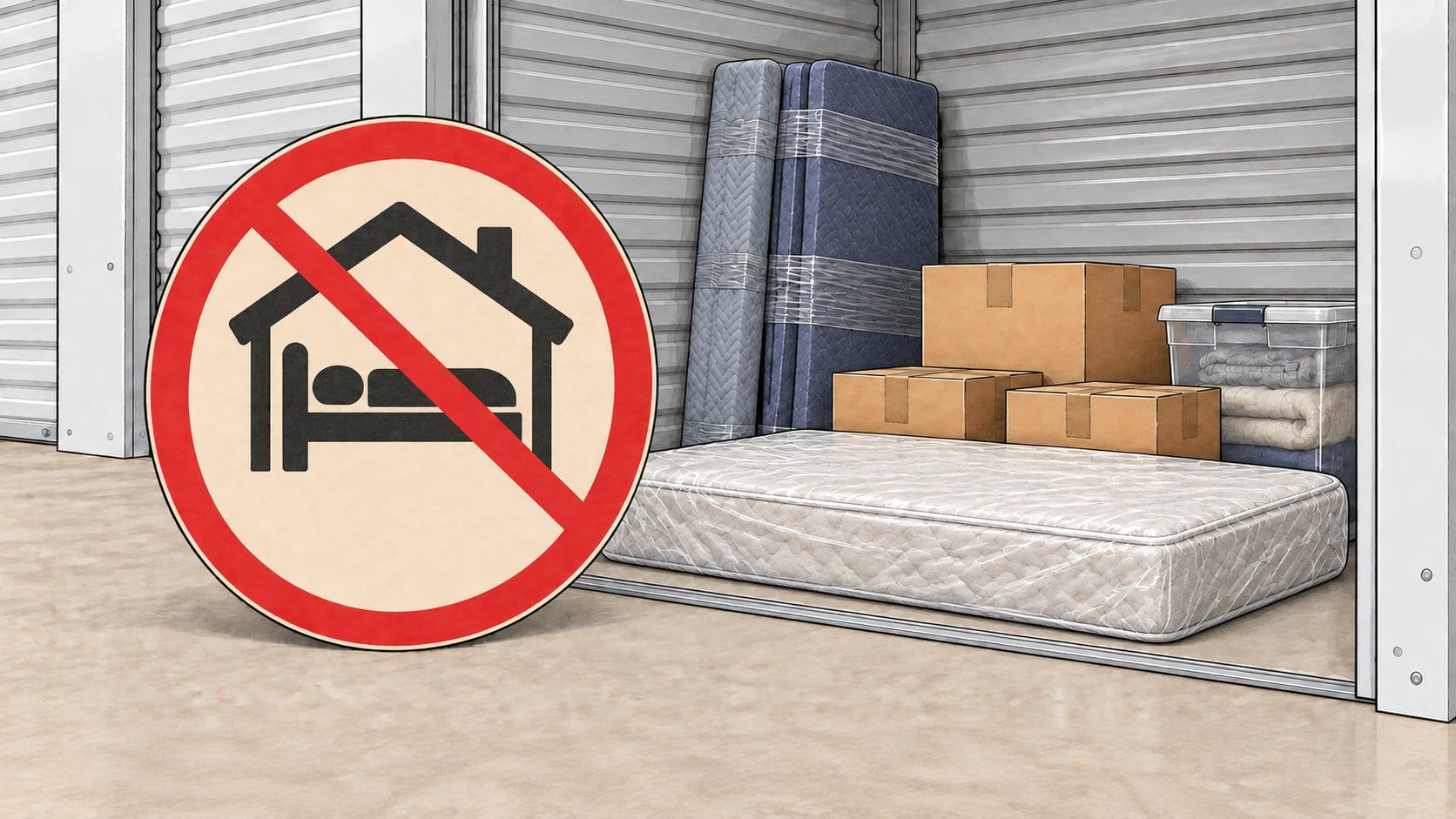
Can you live in a storage unit? No. Texas law says a tenant may not use a self-service storage facility as a residence. A storage unit is rented for one job, keeping your belongings, and it does that job well: your own lock on the door, your own gate code, and your things waiting for you whenever you come.
We're a family-owned business renting storage units in Rockport, Texas. What follows is the law in plain words, what a unit is for, and the everyday questions about what you can keep in one. If you're asking because you need somewhere to stay, there's a section near the end with where to call.
Is it legal to live in a storage unit in Texas?
No. Chapter 59 of the Texas Property Code, the part of Texas law that covers self-storage, says it in one line in Section 59.009: a tenant may not use or allow the use of a self-service storage facility as a residence. That covers letting someone else stay in a unit as much as staying in one yourself. Section 59.004 adds that, except as the chapter itself provides, a storage company and a tenant can't vary the chapter's provisions by agreement.
The same chapter describes what a storage facility is. Section 59.001 defines a self-service storage facility as real property that is rented to be used exclusively for storage of property and is cared for and controlled by the tenant. A storage unit, in other words, is a place for things.
Chapter 59 also sets out the rest of the rules between a storage company and its tenants, from the lien on stored property to how notices are sent. Our post on storage auctions in Texas goes through those sections one at a time.
Can you sleep in a storage unit during the day?
A storage unit is rented for storing your things, and Texas law bars using a storage facility as a residence. If you're thinking of using a unit for anything beyond storing and fetching your belongings, ask us first, during phone hours, before you plan on it.
What a storage unit is for
A storage unit holds the things you want to keep but don't need at hand. That covers a lot of life:
- A move: the furniture and boxes from one home while the next one gets ready.
- A smaller home: the pieces you're not ready to part with after downsizing.
- The seasons: patio furniture, holiday decorations and beach gear when they're out of season.
- A long stay away: a household's worth while you're deployed, working away or traveling.
- A small business: stock, spare equipment and boxed records.
- A renovation: the furniture from the rooms being worked on.
In each case, the unit is where the things wait and you're the one who comes and goes.
The size follows from what's going in. A dorm room's contents fit a 5x10, and a studio apartment, appliances included, fits a 10x10.
A one-bedroom home with its appliances comes to about 113 square feet, which takes a 10x15 with a path to the back, and a two-bedroom apartment comes to about 160, a 10x20. Our posts on 5x5 and 5x10 units, the 1-bedroom and the 2-bedroom work those lists through. Our post on long-term storage covers stays of many months, and the one on how to rent a storage unit goes through renting and the lease.
How long you can keep things in a unit
You can keep your things in a unit for as long as the rental continues. How long that is starts with the lease: a storage lease can set a minimum term, so ask about it before you sign, wherever you rent.
Our storage units are rented on a lease that continues month to month once its minimum term is met, and the rental carries on from one month to the next until it's ended in writing. A stay of a few months or a few years runs the same way.
Coming and going from your unit
You can get in from 5 AM until 10 every night, seven days a week, with your own gate code. If you rent online, your gate code is emailed to you after you finish, and it works right away.
Every one of our units is at ground level, so fetching something is a matter of driving in, opening your lock and taking it out. A visit can be a few minutes on the way to work, or a Saturday morning spent rearranging.
Keep a list of what's in each box on your phone, and put the things you'll want often nearest the door. Our post on how to pack for storage covers labels and loading so the box you need is easy to reach.
Before you rent a unit
A few questions are worth asking any storage company before you sign:
- What's the minimum term, and how much written notice ends the rental?
- When can you get in, and will you have your own gate code?
- Is the unit at ground level, and how do you get from the car to the door?
- How will notices reach you, by email or by mail?
- Which sizes does it rent, and where are the rates listed?
Our post on how to choose a storage unit goes through each one.
Can you store a refrigerator in a storage unit?
Yes, a refrigerator can go into a storage unit once it's empty and clean. GE Appliances' storage advice for a refrigerator going out of use for more than a month is to remove all the food, unplug it, clean the inside with a baking soda solution of 1 tablespoon to a quart of water, wipe it out, and leave the doors open.
Unplug it a day ahead with a towel underneath so any frost can melt, and prop the doors open with a rolled towel taped in place for the move. A refrigerator stands upright on the floor, so measure its footprint and plan it into the size you rent.
Can you store clothes in a storage unit?
Yes. Clothes store best when they go in clean and folded loosely. Wash everything first, and pack it in plastic bins with lids, with the heavier things at the bottom.
The Canadian Conservation Institute's notes on storing textiles flat say to keep folding to a minimum. Label each bin on two sides with the season and whose clothes are inside, so the winter coats come out without opening every bin.
Furniture, mattresses and papers
Furniture stores well when it goes in clean and taken apart where it's made to come apart. The Canadian Conservation Institute's basic care guide for wood furniture says to remove objects from the surface and then remove drawers, shelves and doors before moving a piece. Our post on how to store furniture goes piece by piece.
A mattress goes in lying down. Sealy's storage advice is to store a mattress as flat as possible with little to nothing stacked on top.
Papers and photographs go in boxes or bins big enough for them to lie flat. The National Archives' advice on storing family papers asks for boxes big enough for the originals to lay flat or upright without folding or bending. Keep the ones you couldn't replace with you. Our post on climate-controlled storage goes through which belongings need it.
What from the kitchen can go into a storage unit?
Most of the kitchen can go into a storage unit: the dishes, the pots and pans, the small appliances and the table and chairs, cleaned and packed. Wrap the dishes, stand plates on edge in small boxes, and wipe out the small appliances before they're boxed.
The pantry stays at home, goes to family, or is donated before a move, since food, canned goods included, is never stored with us. Gas cans and propane tanks are never stored with us either, and anything with a fuel tank needs our written permission before it goes in, a lawn mower included. Batteries are never stored with us.
Keeping a unit easy to use
A few habits keep a unit pleasant to visit. Everything goes in clean and fully aired out, and nothing goes in damp. Furniture gets a cotton sheet over it, and boxes sit on pallets or boards with a little space between the stacks and the walls.
The things you'll want during the stay go in last, so they're at the front. Our FAQ answers the common questions about renting with us.
Insurance for what's stored
Check how your own policy treats things kept away from home. The Texas Department of Insurance's page on storage units says a home or renter's policy probably gives you some coverage for things stored away from home, usually limited to 10% to 20% of your personal property limit, and suggests telling your agent what you have and where you keep it. Our post on renters insurance and storage units goes through the questions to ask.
If you need a place to stay
If you're searching this because you need somewhere to live, you can reach help by phone. 2-1-1 Texas, run by the Texas Health and Human Services Commission, helps people find help with food, health, housing and more, and its listings include rent payment assistance and transitional housing and shelter. You can reach it by dialing 2-1-1.
If you're between homes and need a place for your things while you sort out the next step, a storage unit can hold them, and your belongings will be waiting when you're settled. Our post on moving storage covers storage between homes, and the one on student storage covers a summer between school years.
Storing with us in Rockport
Rockport sits between Aransas Bay and Copano Bay, and 298 of our 558 units are climate-controlled.
Siyata Storage is at 825 W Market Street. Some older listings show 835 — that is a separate private building next door, not us. Directions are on our Contact page.
The rate for every size we have open is on our price list. Emilio answers the phone 8 AM–5 PM Monday–Saturday, and we respond to every message during those hours.
Tell us what you're storing and we'll help you pick a size. Call 361-200-1492, 8 AM to 5 PM Monday to Saturday. Hablamos español.