
Student Storage: Summer Storage for College Students
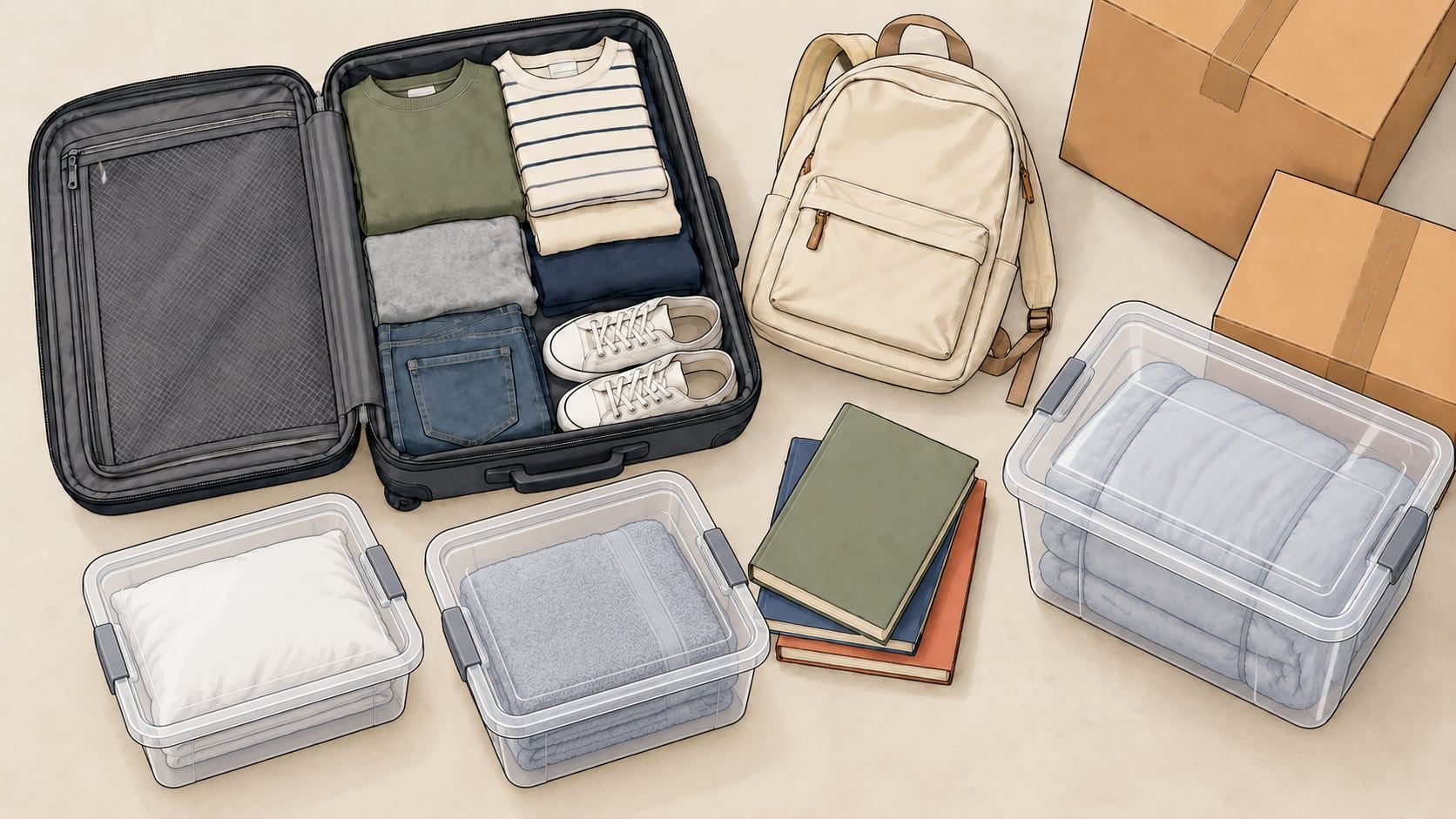
The last exam is nearly behind you, the residence hall closes soon, and everything in your room needs somewhere to go until August. Student storage is a self-storage unit you rent for the summer, fill with the things you'll want back in the fall, and empty again when the new year starts, so the drive home carries just what you need over the break.
We're a family-owned business renting storage units in Rockport, Texas. What follows works for a unit anywhere: what to store and what to bring home, the size that fits a dorm room, packing for a summer away, and moving back out when classes start again.
Storage units for college students
A storage unit for a college student works the way any self-storage rental does. You rent a unit, put your own lock on the door, and come and go during the property's gate hours.
College student storage is the same rental, timed around the school year. Our post on what a storage unit is for answers the common questions about what can go in one.
Whether you can rent for the summer months alone depends on the minimum term in the lease, so ask about it before you sign, wherever you rent. A storage lease can set a minimum term, and it's one of the first things to look for.
Our storage units are rented on a lease that continues month to month once its minimum term is met, and the rental carries on from one month to the next until it's ended in writing. If plans slip, such as a later flight home or a fall move-in date that moves back a week, the unit stays yours while you wait.
How to plan a student move with storage
Start with two dates: the day your residence hall or apartment lease ends in spring, and the day you can move back in for fall. Your housing website or your lease has both, and the weeks between them are the summer the unit has to cover.
Student summer storage goes more smoothly when the unit is rented before exams start. The gate code and the unit number are settled early, and the last week is left for the move itself.
A few weeks before the end of the semester, sort the room into three piles: what comes home with you, what goes into storage, and what you're done with. Give away or recycle the last pile early, before move-out week gets busy.
Gather boxes, tape, a marker and a few plastic bins while there's still time to shop. Line up a ride and a helper for the day, and pack a few boxes first to see how many carloads the room will take.
There's real relief in turning in the room key with the room already empty and the summer clear ahead.
A summer storage checklist
The summer in order, from the first date to the last:
- Find your spring move-out date and your fall move-in date.
- Ask about the minimum term, then rent the unit before exams start.
- Sort the room into what comes home, what's stored and what goes.
- Gather boxes, tape, a marker, bins and your own lock.
- Wash clothes and bedding, and clean out the mini fridge.
- Pack, label each box on two sides, and photograph each one.
- Ask whoever holds your family's home policy how it treats a storage unit.
- Move in early in the day, inside the gate hours.
- Put your fall move-out date on your calendar, with the notice date 10 days ahead of it.
What to store and what to bring home
Store the things you'll want back in the fall and won't need over the break: bedding and towels, out-of-season clothes, books and class notes, a desk lamp, a rug, a desk chair, a microwave, a mini fridge and the small furniture you bought for the room.
Bring home anything you'll use over the summer or couldn't replace: your laptop, phone and chargers, medicine, glasses, keys, important papers, jewelry and anything of sentimental value. Batteries are never stored with us, so anything that runs on one, from a speaker to a portable charger, goes home with you too.
Food, gas cans and propane tanks are never stored with us, and anything with a fuel tank needs our written permission before it goes in. Empty the mini fridge and the snack drawer completely before they're packed.
A few things react to heat. The Canadian Conservation Institute lists candles, soaps and wax seals among the things that soften and deform for good when they get too warm. It says discs, tape cassettes and other plastic objects distort, and some cosmetics deform. Keep those with you over the summer, or in a climate-controlled unit, and our post on climate-controlled storage goes through which belongings need it.
What size storage unit for a dorm room?
A 5x10 is the size our Size Guide gives for a dorm room. It's 50 square feet, about the size of a walk-in closet, and holds a dorm room's contents. Our post on 5x5 and 5x10 storage units goes through both small sizes.
A 5x5 is 25 square feet, about the size of a large closet, with room for boxes and a few small things. It can be enough when most of what you're storing is boxes.
Floor space is what decides it. Sterilite's 27-gallon Industrial Tote measures 28 1/2 inches long and 19 5/8 inches wide on the outside. Six of them fit across the floor of a 5x5 in a single layer, and twelve across a 5x10, before anything is stacked.
If you have a mattress of your own, Sealy's mattress size guide gives a twin as 38 inches wide and 75 inches long, about 20 square feet. Sealy's storage advice is to keep a mattress as flat as possible with little to nothing stacked on top, and laid flat, a twin takes about two-fifths of a 5x10's floor.
To see it before you rent, mark a square 5 feet on each side on a floor at home or in a garage with painter's tape, and set the boxes and furniture inside it. If they spill over, mark out a 5x10 the same way. A bike can stand along one wall of a 5x10 with its front wheel turned, leaving the rest of the floor for boxes.
If the list runs to a full-size bed, a sofa or a dresser from an off-campus apartment, look at the larger sizes. Our Size Guide covers all 13 sizes we rent, with what fits in each. Our post on what size storage unit you need for a 1-bedroom works through an apartment's worth, and the one on how big a 10x10 is covers the next size up from there.
Packing a dorm room for storage
Boxes of one or two sizes stack straight and carry easily. Label each one on two sides with what's in it and keep a list on your phone, so in August you can find the winter coat without opening every box. Our post on how to pack for storage goes box by box.
Keep each box to a weight you can lift close to your body. NIOSH's guidelines for lifting give 51 pounds as the most to lift with two hands under ideal conditions, and suggest putting fewer items in a container to make it lighter. Books and notes go in small boxes for that reason.
Wash clothes, towels and bedding before they're packed, so they come back in August the way they went in. The Canadian Conservation Institute's notes on storing textiles flat say to keep folding to a minimum, so fold them loosely and put the heavier things at the bottom of each box.
Papers you're keeping, such as notes for next year's classes, a certificate or a piece of artwork, travel best in a box big enough for them to lie flat. The National Archives' advice on storing family papers asks for boxes big enough for the originals to lay flat or upright without folding or bending.
The mini fridge needs a little care. GE Appliances' storage advice for a refrigerator going out of use for more than a month is to remove all the food, unplug it, clean the inside with a baking soda solution of 1 tablespoon to a quart of water, wipe it out, and leave the doors open.
Unplug it the day before move-out with a towel underneath, so any frost has time to melt. Once it's clean, prop the door open with a rolled towel taped in place, so it travels and stays open.
Pack one box last for the first night back in the fall: sheets, a towel, a pillowcase and the shower things you'd otherwise hunt for. Load it nearest the door so it's the first thing you reach in August.
Take a few photos as you pack. The Texas Department of Insurance's home insurance guide suggests photographing each room and opening drawers to photograph what's inside, and the same idea works for boxes: a picture of each one open, then closed with its label showing.
Insurance while you're away
A student storing a dorm room's worth of things may already be covered through home. TDI's renters insurance page says that if you're a dependent, your parents' homeowners policy may cover your things even if you're not living at home, usually up to 10% of its personal property coverage.
Whoever holds that policy can call their agent before the summer starts and ask how it treats things kept in a storage unit. Our post on renters insurance and storage units goes through the questions to ask.
Summer on the Texas coast is also hurricane season, which the National Weather Service says runs from June 1 to November 30 each year. Keep your list and photos in your email as well as on your phone, and our post on hurricane storage on the Texas coast covers planning ahead for a storm.
Renting from campus before you head home
You can rent from your dorm room before you drive home. Our online rental runs in three steps, Select Storage Unit Size, Enter Billing Info and Confirm Information, and the lease opens on your phone so you can go through it before you sign.
If you rent online, your gate code is emailed to you after you finish, and it works right away. Our post on gated storage units explains how the gate and your code work. Keep a note of the code somewhere other than your phone too, in case its battery runs flat at the gate.
Ask about the minimum term when you rent, and put the move-out date you're planning on your calendar now. In the lease, find the paragraphs on the minimum term, on how you end the rental and on how much written notice it asks for. Our post on how to rent a storage unit goes through the lease and the rest of renting.
You can get in from 5 AM until 10 every night, seven days a week. Bring your own lock on move-in day, along with the code.
If you're home in the area for the summer, you can come to your student storage unit during those hours for anything you packed and find you need, such as a fan or a box of summer clothes.
Moving day in the summer heat
Plan the heavy part of the day for the morning. NOAA's climate normals for the Corpus Christi airport, southwest of Aransas County, give a normal daily high of 87.3 degrees in May, 91.6 in June and 95 in August.
The National Weather Service's heat advice is to reduce, eliminate or reschedule strenuous activities until the coolest time of the day, and to drink plenty of water even if you don't feel thirsty. A 5 AM gate opening makes an early start easy.
Every one of our units is at ground level, so the boxes go from the car to the unit without stairs. Bring a hand truck or a dolly if you have one, and a pair of work gloves. Load the heaviest boxes first and keep them low, then the furniture, and put the things you'll want first in August nearest the door.
Coming back in August
Plan the trip back around your fall move-in date. If your housing sets a move-in day and time, check it before you choose the day you empty the unit, so the boxes go straight from the unit to your room.
When you're ready to move out, give at least 10 days' written notice. Rent runs through the end of the month you move out in. If your move-out date falls in the last 10 days of a month, call us during phone hours and ask what you'll owe, so you know before you choose the day.
On the day, take out the first-night box, then the rest in the order you'll unpack it at school. Empty the unit, sweep it out and take your lock off the door.
Student storage with us in Rockport
Rockport sits between Aransas Bay and Copano Bay, and 298 of our 558 units are climate-controlled. Our climate-controlled units are interior units on an HVAC system, held within a steady temperature range. Our drive-up units open onto the drive aisles, where you park at your unit door and unload a few steps. The Climate-Controlled page covers the interior units.
Siyata Storage is at 825 W Market Street. Some older listings show 835 — that is a separate private building next door, not us. Directions are on our Contact page.
The rate for every size we have open is on our price list. Emilio answers the phone 8 AM–5 PM Monday–Saturday, and we respond to every message during those hours.
Tell us what you're storing and we'll help you pick a size. Call 361-200-1492, 8 AM to 5 PM Monday to Saturday. Hablamos español.