
How to Choose a Storage Unit: What to Check Before You Sign
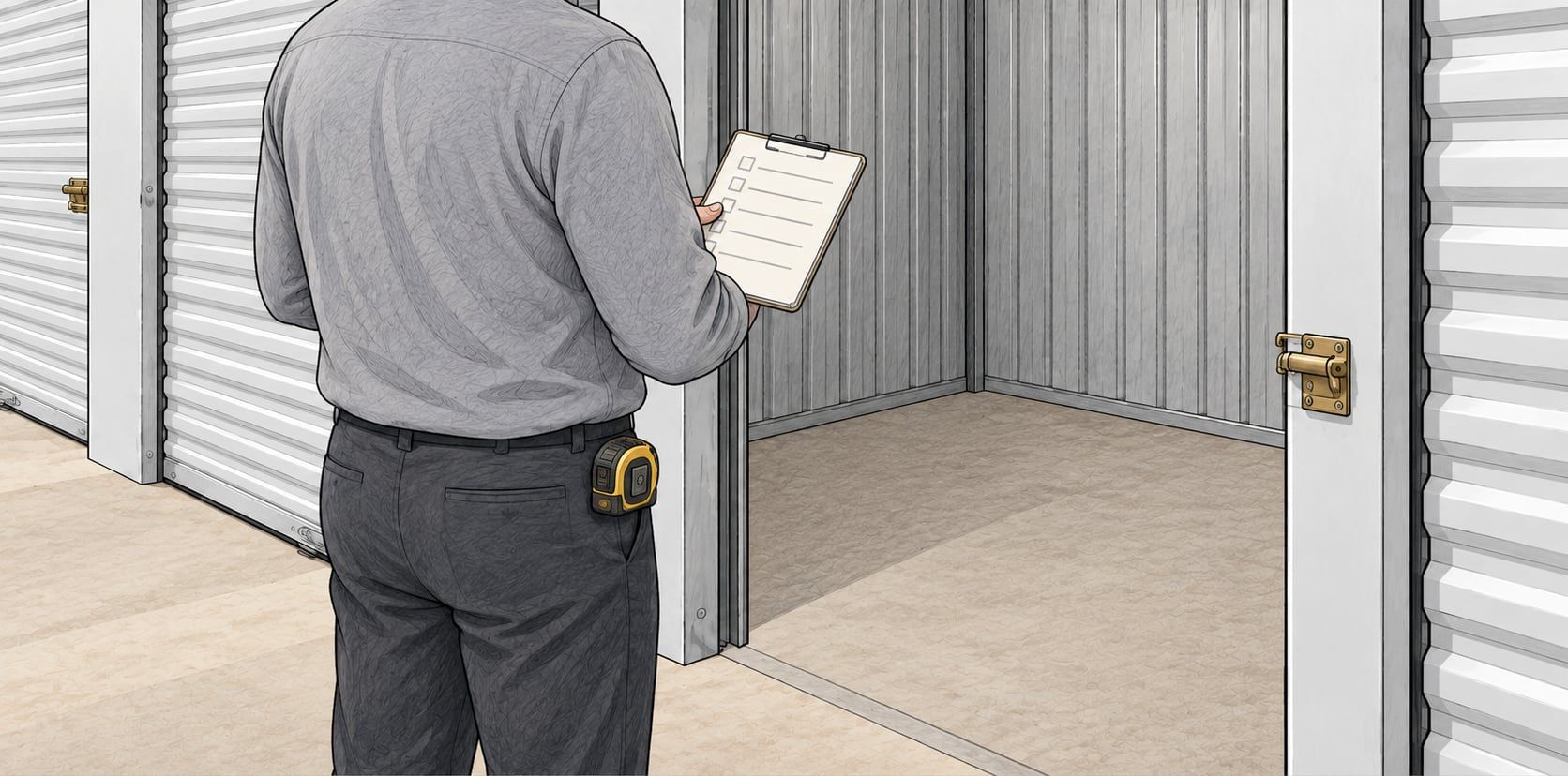
How to choose a storage unit comes down to a handful of things you can check before you sign: the size, how you get in, the lease and the rate in writing, how you reach the unit, and who picks up the phone. Each one takes a few minutes, and together they tell you whether a place fits the way you'll use it.
We're a family-owned business renting storage units in Rockport, Texas. The checklist that follows works anywhere, and after each item you'll find how it works with us. It's a good feeling to sign a lease you've actually read, for a unit you already know will fit.
How do storage units work?
Storage units work as a monthly rental of a lockable space. You choose a size, sign a lease, put your own lock on the door, and come and go during the hours the property is open to you. Within the lease's rules on what can be stored, what goes in and when it comes out is up to you.
Texas law describes it plainly. In Section 59.001, Chapter 59 of the Texas Property Code calls it a self-service storage facility, meaning real property rented to be used exclusively for storage of property and cared for and controlled by the tenant.
The same section calls the tenant the person entitled under a rental agreement to the exclusive use of the storage space. Section 59.021 gives the storage company a lien on what's stored for charges that are due and unpaid, and our lease has a paragraph on that lien.
So what are storage units, in the simplest terms? They're rooms you rent to keep your own things in, under your own lock, on your own schedule.
What is mini storage?
Mini storage is another name for self-storage. The U.S. Census Bureau's industry classification puts the two together under one heading, Lessors of Miniwarehouses and Self-Storage Units, describing businesses that rent or lease space where clients can store and retrieve their goods.
Whatever the sign says, mini storage, mini warehouses or self-storage, the checklist applies the same way.
How does self storage work?
Self storage works in a few steps.
- Pick a size from the floor your things need.
- Rent online or by phone, and read the lease before you sign it.
- Get your gate code, and bring your own lock.
- Move in during the gate hours, and come and go as you need.
- When you're done, give the written notice the lease asks for, empty the unit and take your lock off.
How long you keep a unit depends on the lease. A storage lease can set a minimum term, so ask about it before you sign, wherever you rent. Our storage units are rented on a lease that continues month to month once its minimum term is met, and the rental carries on from one month to the next until it's ended in writing.
Our post on how to rent a storage unit goes through each step in detail.
Start with the size
Size comes first, because it decides which units you're comparing. Floor is the number to plan with: measure your big pieces, add up the floor each one covers, count the boxes as stacks, and decide whether you want a path to the back.
Our Size Guide covers all 13 sizes we rent, with what fits in each. Our posts on 5x5 and 5x10 units, how big a 10x10 is, how big a 10x15 and a 10x20 are, and what size you need for a 1-bedroom or a 2-bedroom work through the arithmetic.
If you're between two sizes, sketch both on graph paper with each piece drawn to scale, and the one that leaves you the path you want is your size.
We rent two types of storage units: drive-up and climate-controlled. A drive-up unit's door opens onto a concrete drive aisle, so you park at your unit door and unload a few steps. A climate-controlled unit is inside its building, and you reach it through the building entrance.
Then decide what kind of unit your things need. Some belongings react to heat and cold, and our post on climate-controlled storage goes through which ones need it.
A checklist for choosing a storage unit
Ask every place the same seven questions, and write the answers side by side.
1. When can you get in? Ask for the gate hours, and check they fit the times you'll actually visit, early mornings, evenings and weekends included. Ask for the phone hours too, since the two can differ. With us, you can get in from 5 AM until 10 every night, seven days a week.
2. Will you have your own code? A code of your own means the gate opens for you, on your schedule. With us, every tenant has their own gate code. If you rent online, your gate code is emailed to you after you finish, and it works right away.
3. What's the standard rate? Compare the standard rate with the standard rate, for the same size and the same kind of unit, rather than comparing first bills. The rate for every size we have open is on our price list, and the standard rate is written in the lease from the first day.
Some companies show an introductory discount alongside the standard rate. Wherever you see one, look for the standard rate beside it and the date the discount ends, so you know what you'll be paying once it's over. For the exact total on the day you plan to move in, call us during phone hours and we'll go through it with you.
4. What does the lease say about rate changes? Ask to see the rate-change clause in writing before you sign, and read it the way you'd read any other contract. Any later change comes with at least 30 days' written notice, because your signed lease requires it.
5. How will you reach the unit? Ask whether it's at ground level, and how you get from the car to the door. Every one of our units is at ground level, and the buildings have ramps at their entrances.
6. What does climate control mean there? Ask for the equipment described in writing, whatever the place calls it, and whether the unit is inside a building. Our climate-controlled units are interior units on an HVAC system, held within a steady temperature range.
7. Who answers the phone? Call during the day with one of your questions and see how it goes. Emilio answers the phone 8 AM–5 PM Monday–Saturday, and we respond to every message during those hours.
A side-by-side sheet
Copy this onto a page, one column for each place you're considering, and fill it in as you call:
| Question | Place 1 | Place 2 | Place 3 |
|---|---|---|---|
| Gate hours | |||
| Phone hours | |||
| Your own code | |||
| Size and kind of unit | |||
| Standard rate | |||
| Rent due date | |||
| Rate-change notice, in writing | |||
| Minimum term | |||
| Written notice to move out | |||
| Ground level, and the way in | |||
| Climate equipment, in writing |
Most of it can be filled in from each company's website and one phone call. With the answers in one place, the choice comes down to the size and how you'll use the unit, and the sheet makes that easy to see.
Reading the lease before you sign
The lease is where the answers are put in writing, so read it all the way through. Find the rate and the due date, the minimum term, how you end the rental, and how much written notice it asks for. Rent with us is due in full on the 1st.
Find the paragraph on the landlord's lien too. Under Section 59.041 of the Texas Property Code, a storage company can enforce its lien by seizing and selling property only under a contractual landlord's lien that's underlined or printed in conspicuous bold print in a written rental agreement. Our post on storage auctions in Texas goes through what that means.
Check how notices will reach you. Section 59.043 sends notices to the email or postal address in the rental agreement or in a later written notice from the tenant, and allows email when the lease says so in underlined or bold print. Give an address you check, and keep it current.
Ask what can't be stored, and plan around it before moving day. Food, gas cans and propane tanks are never stored with us, batteries are never stored with us either, and anything with a fuel tank needs our written permission before it goes in, a lawn mower included. Our post on what a storage unit is for covers what can go in.
Storage for seniors and retirees
Storage units for seniors are the same units, chosen with the carrying in mind. If stairs or long carries are hard, look for units at ground level with a short, level way in from where you park.
Every one of our units is at ground level, and the buildings have ramps at their entrances. With a drive-up unit, the car parks right at the door.
A move to a smaller place can leave furniture and keepsakes you aren't ready to part with. Keep the keepsakes you couldn't replace with you, and box the rest so the right box comes out when it's wanted. The National Archives' advice on storing family papers asks for boxes big enough for the originals to lay flat or upright without folding or bending.
Bring help for moving day, and a hand truck. Bring your own transport, or your mover can unload straight into the unit, and you can stand at the door and say where each piece goes.
NIOSH's lifting guidelines suggest putting fewer items in a container to make a load lighter, so keep the boxes small, and put the ones you'll want often at waist height near the door. Plan the carrying for the cool part of the day: our gate opens at 5 AM.
Our post on long-term storage covers keeping things for months.
The buildings and the location
Ask how old the buildings are and how they're laid out, including whether a unit opens onto a drive aisle or sits inside a building, since that decides how you load it. Our eleven single-level buildings went up between 2017 and 2025, and six of them were finished in 2025. Our About page has more about the property.
Choose a place on a road you already drive, so a quick visit fits into an errand. We're on the south side of W Market Street, which is FM 1069, about a mile west of the middle of town, and from Fulton it's about five miles and eight minutes. If you're moving here, our post on moving storage covers the move itself.
If a gated property with your own code is on your list, our post on gated storage units goes through how the gate, codes and hours work.
Once you've chosen
Rent the unit, read and sign the lease, and save the gate code somewhere other than your phone too. Put the lease's notice period on your calendar the day you sign, so it's there when plans change. Ask which kinds of lock fit the doors, and bring your own on moving day.
Make a list of what's going in, box by box, and take a few photos as you pack. The Texas Department of Insurance's home insurance guide says a complete list of your property will help you decide how much coverage you need and will make filing claims easier, and our post on renters insurance and storage units goes through the questions to ask your agent.
If you're a student or the parent of one, our post on student storage covers summer storage for college students.
Choosing with us in Rockport
Rockport sits between Aransas Bay and Copano Bay, and 298 of our 558 units are climate-controlled.
Siyata Storage is at 825 W Market Street. Some older listings show 835 — that is a separate private building next door, not us. Directions are on our Contact page.
Tell us what you're storing and we'll help you pick a size. Call 361-200-1492, 8 AM to 5 PM Monday to Saturday. Hablamos español.