
Moving Storage: Using a Unit When You Move to Rockport
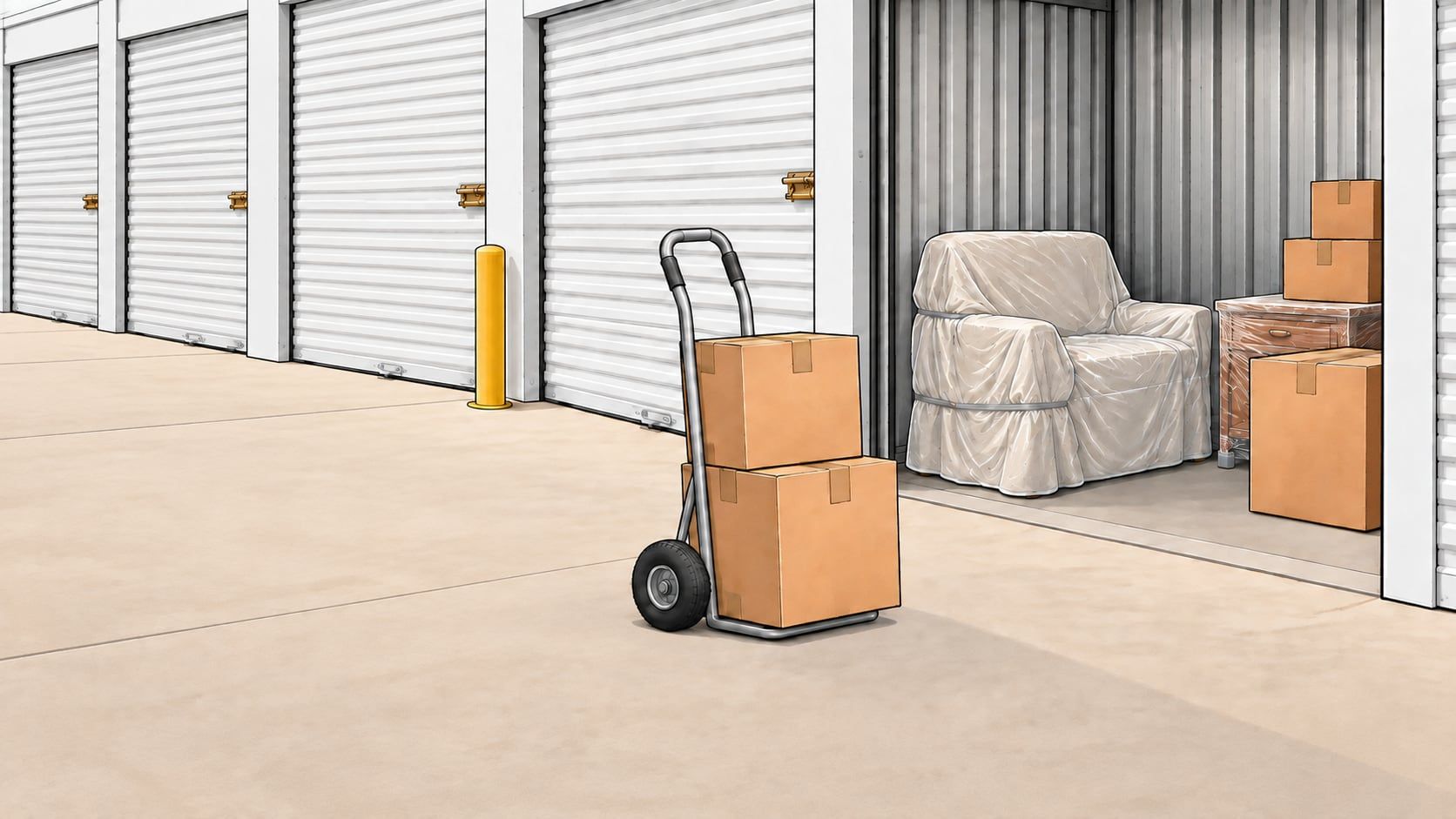
Moving storage gives your things a place to wait while a move comes together: a storage unit you rent before, during or after the move, so the furniture and boxes have somewhere to go while the dates line up. A storage unit for moving can hold a house's worth while you're between homes, the extra pieces that won't fit the new place, or what you clear out of rooms to get a house ready to sell.
We're a family-owned business renting storage units in Rockport, Texas. What follows works for any move with a storage unit in the middle of it, with the Rockport details for anyone moving here. A move feels lighter once the boxes have a place to go and the dates stop pressing on you.
Storage unit for moving
A storage unit for moving is an ordinary self-storage rental used around a move. You rent the unit, put your own lock on the door, and move things in and out during the gate hours, on whatever schedule the move needs.
It can help at three points. Before the move, clearing rooms makes a house easier to show and to pack, and the extra chairs, the crowded bookshelves and the out-of-season clothes can go first. In between, it holds everything when the old place ends before the new one starts. After the move, it keeps what the new place can't take yet, while you settle in or while floors and paint are finished.
How long you can keep a unit depends on the lease. A storage lease can set a minimum term, so ask about it before you sign, wherever you rent.
Our storage units are rented on a lease that continues month to month once its minimum term is met, and the rental carries on from one month to the next until it's ended in writing. That helps in a move, because closing dates and repair schedules have a way of slipping, and the unit stays yours while you wait.
Storage between moves
Storage between moves is a unit that holds your things in the gap between one home and the next, and that gap is where a unit does the most work. Say a sale closes at the end of one month and the new house is ready in the middle of the next, or a lease ends a few weeks before the next one starts.
Pack everything you won't need during the gap, move it into the unit, and live out of a few suitcases and a box of kitchen basics wherever you're staying. When the new keys are in your hand, the unit empties into the new house in one trip or a few. During the gap, you can come to the unit during gate hours for anything you find you need, such as a winter coat or a box of papers.
If you're between rentals in Rockport, a unit holds the furniture while you look, and you can rent one online before you've found the next place. Our post on what a storage unit is for answers the common questions about what can go in one. Keep a short list of what's in the unit on your phone, so you can find a document for a viewing or a lease signing without opening every box.
When you know the new move-in date, pick the day you'll empty the unit and count back from it. When you're ready to move out, give at least 10 days' written notice. Rent runs through the end of the month you move out in. If your move-out date falls in the last 10 days of a month, call us during phone hours and ask what you'll owe, so you know before you choose the day.
Our post on how to rent a storage unit goes through notice and moving out.
Moving to Rockport from out of town
You can rent before you arrive. Our online rental runs in three steps, Select Storage Unit Size, Enter Billing Info and Confirm Information, and you read and sign the lease on your phone.
If you rent online, your gate code is emailed to you after you finish, and it works right away. Keep a note of the code somewhere other than your phone too, in case its battery runs flat at the gate, and bring your own lock.
Put the building letter and unit number in the same note, so the last few minutes of a long drive go straight to the right door. Our post on gated storage units explains how the gate and your code work.
We're on the south side of W Market Street, which is FM 1069, about a mile west of the middle of town. From Fulton it's about five miles and eight minutes.
You can get in from 5 AM until 10 every night, seven days a week. If the drive down is long, an overnight stop on the way puts you at the gate with the whole morning ahead.
If you're moving to Rockport and deciding which storage company to call first, ask each one the same few things: the gate hours, how you get your code, whether the unit is at ground level, which sizes it rents and where the rates are listed, the minimum term, and how much notice moving out takes. Our post on how to choose a storage unit goes through the rest.
If you're coming down for the winter, as Winter Texans do from October into November, our post on seasonal storage for Winter Texans and second homes covers the stays that come back every year.
Hiring movers when a unit is part of the plan
Moving and storage can be one plan with two parts, the mover and the unit. Bring your own transport, or your mover can unload straight into the unit. Either way, give whoever is driving the building letter, the unit number and the gate hours, and plan to meet the crew at the gate.
A mover quoting a storage move, such as emptying a 10x10, needs two things: the unit's size and what's in it. A list by room and a few photos of the open unit give them both.
The Texas Department of Motor Vehicles says an accurate estimate depends on telling the mover about every item to be moved and any extra services, such as stairs or long carries. Every one of our units is at ground level, which is worth saying when you ask.
By law, Texas movers must be licensed with TxDMV. Before you hire one for a move within Texas, look up its certificate number in TxDMV's Truck Stop lookup, where a licensed mover has an Active certificate number on file. TxDMV also requires licensed movers to show their name, TxDMV certificate number and USDOT number on both sides of the truck.
A licensed mover gives you a written proposal and a moving services contract before loading. TxDMV says the proposal can be binding, which states the exact total, or not-to-exceed, which states the most you can be charged and allows less.
Get every agreement written into the contract, since TxDMV's advice is to rely on no verbal agreements. The proposal must also explain when you'll pay the mover and what form of payment is accepted, and TxDMV says to be prepared to pay the maximum shown on it.
Licensed Texas movers must also give you TxDMV's document Your Rights and Responsibilities When You Move in Texas before they load your things. Read it before moving day, while there's time to ask questions.
For a move from another state, the Federal Motor Carrier Safety Administration's steps to select a mover start with written estimates from several movers, based on an in-person inspection of your household goods. A U.S. DOT number is required by FMCSA for interstate moves, and the mover is required to give you the federal booklet Your Rights and Responsibilities When You Move.
FMCSA's mover search tool shows registered interstate movers and their complaint history, so look each one up before you choose. Then give the mover you hire the unit's address and size along with the new home's, so both stops are in the estimate.
FMCSA also lists red flags to watch for when you hire a mover. Among them: a mover or broker that gives an estimate by phone or online without looking at your household goods; no written estimate, or a cost to be decided after loading; a demand for cash or a large deposit before the move; a request to sign blank documents; and a phone answered with "Movers" or "Moving Company" rather than the company's name.
If a mover holds your things for you, how long it keeps them is what you agree on. For an interstate move, FMCSA's guide to the shipment rules says that when storage-in-transit is about to run out, the mover must tell you in writing, at least 10 days ahead, the date it converts to permanent storage, that the mover's liability will end, and that your things will then be subject to the warehouse's rules, regulations and charges.
TxDMV points out that a mover's limits on liability are not the same as insurance, and that transit insurance can be bought to help cover loss or damage to your goods. Ask the mover about its liability before you sign, and ask your own agent how your policy treats your things in transit and in storage.
Some movers will prepare a descriptive inventory. TxDMV says it should list every item and its condition and be signed by you and the mover at both ends of the move, so review it for accuracy before you sign. At delivery, the mover must give you a completed copy of the moving services contract, signed by both of you. TxDMV's advice is to check the condition of your things and note anything on the contract before you sign.
If something arrives damaged, TxDMV says to file a written claim with the mover within 90 days from the date of delivery, and to keep the boxes and packing along with the damaged goods so the mover can inspect them. If the mover's answer doesn't settle it, TxDMV provides mediation.
Keep the things you couldn't replace with you. TxDMV's advice is to keep valuables such as jewelry and money, medications and important papers out of the mover's truck, and the same thinking applies to the unit: they ride with you.
A moving timeline with a storage unit
- Six to eight weeks out, measure the new home's rooms and decide what goes to the unit.
- Ask about the minimum term, then rent the unit online or by phone.
- Four weeks out, get written estimates and check each mover's registration.
- Two to three weeks out, pack the storage boxes first and move them into the unit.
- The week of the move, pack the first-night box and photograph each room.
- On the day, if the unit is the truck's first stop, load the unit's share last so it comes off first.
- After the move, give the storage company your new address in writing.
- At least 10 days before you empty the unit, give your written notice.
Packing for a move with a unit in the middle
Split the packing in two from the start: boxes for the new home and boxes for the unit. A different color of tape or label for each keeps them apart on moving day, when everything is going somewhere at once.
Label each box on two sides with its room and what's in it, and keep a numbered list on your phone. Our post on how to pack for storage goes box by box, and the one on how to store furniture covers the big pieces.
TxDMV's packing advice is to be careful about overloading boxes, to pack fragile things apart from heavy ones, and to mark the fragile boxes. Keep each box to a weight you can lift close to your body. NIOSH's guidelines for lifting give 51 pounds as the most to lift with two hands under ideal conditions, and suggest putting fewer items in a container to make it lighter.
Food, gas cans and propane tanks are never stored with us, and anything with a fuel tank needs our written permission before it goes in. If a refrigerator is going into storage, GE Appliances' storage advice for one going out of use for more than a month is to remove all the food, unplug it, clean the inside, wipe it out and leave the doors open.
Pack a first-night box for the new home, with sheets, towels, a few dishes, the coffee maker and the chargers, and load it last so it comes off first.
Take photos as you pack. The Texas Department of Insurance's home insurance guide suggests photographing each room and opening drawers to photograph what's inside. Done before the movers arrive, it gives you a record of how everything looked before the move.
Storing furniture during a home renovation
A renovation empties rooms in a different order than a move. Floors, paint and cabinets each want a clear room, and a unit lets the furniture go out once and come back when the work is done. Ask the contractor for the schedule in writing, room by room, and move the furniture out in that order.
If your home is being repaired after a storm, the furniture can wait in a unit while the walls and floors are put right, and come home when the rooms are ready. A unit at ground level makes the loading easier, for you and for anyone helping.
Check your insurance while the furniture is out of the house. The Texas Department of Insurance's page on storage units says a home or renter's policy probably gives you some coverage for things stored away from home, usually limited to 10% to 20% of your personal property limit. It suggests telling your agent what you have and where you keep it, and our post on renters insurance and storage units goes through the questions to ask.
Mattresses go in flat. Sealy's storage advice is to store a mattress as flat as possible with little to nothing stacked on top. Tables come apart where they're made to, and the legs, bolts and brackets go in a labeled bag taped to the piece they belong to.
Downsizing to a smaller home
Moving to a smaller home, whether it's a condo near the water or a house with one less bedroom, starts with deciding what fits. Measure the new rooms first and draw them on paper, with the pieces you plan to bring. Measure the doorways and the turns in the hallways too, since a piece that fits a room still has to get into it.
The pieces that don't fit the plan, and that you're not ready to part with, can go to a unit while you live in the new place and see how it works. Put a date on the calendar to decide on each one.
Children's outgrown clothes, a crib or a high chair kept for a younger child or for grandchildren keep well in labeled bins, sorted by size or age, so the right box comes out when it's needed.
Our post on what size storage unit you need for a 2-bedroom works through a whole home's list, and the one on how big a 10x15 and a 10x20 are covers the two sizes that list lands on.
Choosing the size for a move
Our Size Guide covers all 13 sizes we rent, with what fits in each. For a move, these are the sizes to look at first, with the worked lists from our one- and two-bedroom posts:
- A 5x10 is 50 square feet, about the size of a walk-in closet, and holds a dorm room's contents.
- A 10x10 is 100 square feet, about the floor area of a small bedroom, and holds a studio apartment, appliances included, or the furniture of a room or two.
- A 10x15 is 150 square feet. A one-bedroom home's list, appliances included, comes to about 113 square feet, which fits with a 2-foot path to the back.
- A 10x20 is 200 square feet. A two-bedroom apartment's list, appliances included, comes to about 160, which fits with a narrow path down one side.
- A 15x20 is 300 square feet. A two-bedroom house with its garage and patio set comes to about 199, which leaves room to walk, and a three-bedroom house with its garage and patio comes to about 250, which fits with a path down one side.
Floor area is what decides it. Add up the floor each large piece needs, then the boxes in stacks, and leave a path to the back. If the total falls between two sizes, sketch the unit on graph paper with each piece drawn to scale, and the sketch shows which one works. Our post on how big a 10x10 is shows the method on one size.
Summer moves and hurricane season
A summer move to the coast falls in hurricane season, which the National Weather Service says runs from June 1 to November 30 each year. Keep your inventory, your photos and the mover's paperwork in your email as well as on your phone, and our post on hurricane storage on the Texas coast covers planning ahead for a storm.
Summer is also hot work. NOAA's climate normals for the Corpus Christi airport, southwest of Aransas County, give a normal daily high of 91.6 degrees in June, 93.7 in July and 95 in August.
A few things react to heat. The Canadian Conservation Institute lists candles, soaps and wax seals among the things that soften and deform for good when they get too warm, and says discs, tape cassettes and other plastic objects distort. On moving day, carry those in the car with you, and after that keep them at home or in a climate-controlled unit.
The National Weather Service's heat advice is to reduce, eliminate or reschedule strenuous activities until the coolest time of the day, and to drink plenty of water even if you don't feel thirsty. Our gate opens at 5 AM, so the heavy carrying can be done early.
Moving day at the unit
Our eleven single-level buildings went up between 2017 and 2025, every unit is at ground level, and the buildings have ramps at their entrances. A hand truck and a few furniture blankets make the day easier.
Load the far end of the unit first, with the heaviest pieces and boxes low and against the walls. Leave a path down one side, and put the things you'll want first nearest the door.
Once the move settles, give the storage company your new address in writing. Texas law sends a storage company's notices to the last known address in the rental agreement or in a written notice from the tenant, as Section 59.043 of the Texas Property Code sets out, so the new address on file is how word about your rental reaches you. Our post on storage auctions in Texas goes through those notices.
Unpacking from the unit into the new home
When the new place is ready, empty the unit in the order you'll unpack: beds first, then the kitchen, then the rest room by room. The labels on two sides of each box let the helpers put it straight into the right room.
Before the last trip, give your written notice in time, so the rental ends on the day you planned. On the day, take the last box out, sweep the unit and take your lock off the door.
Moving storage with us in Rockport
Rockport sits between Aransas Bay and Copano Bay, and 298 of our 558 units are climate-controlled. Our climate-controlled units are interior units on an HVAC system, held within a steady temperature range. Our drive-up units open onto the drive aisles, where you park at your unit door and unload a few steps.
Siyata Storage is at 825 W Market Street. Some older listings show 835 — that is a separate private building next door, not us. Directions are on our Contact page, and our Areas We Serve page covers Fulton and the towns nearby.
The rate for every size we have open is on our price list. Emilio answers the phone 8 AM–5 PM Monday–Saturday, and we respond to every message during those hours.
Tell us when you're planning to move in and we'll help you pick a size. Call 361-200-1492, 8 AM to 5 PM Monday to Saturday. Hablamos español.