
How to Rent a Storage Unit Online, Start to Finish
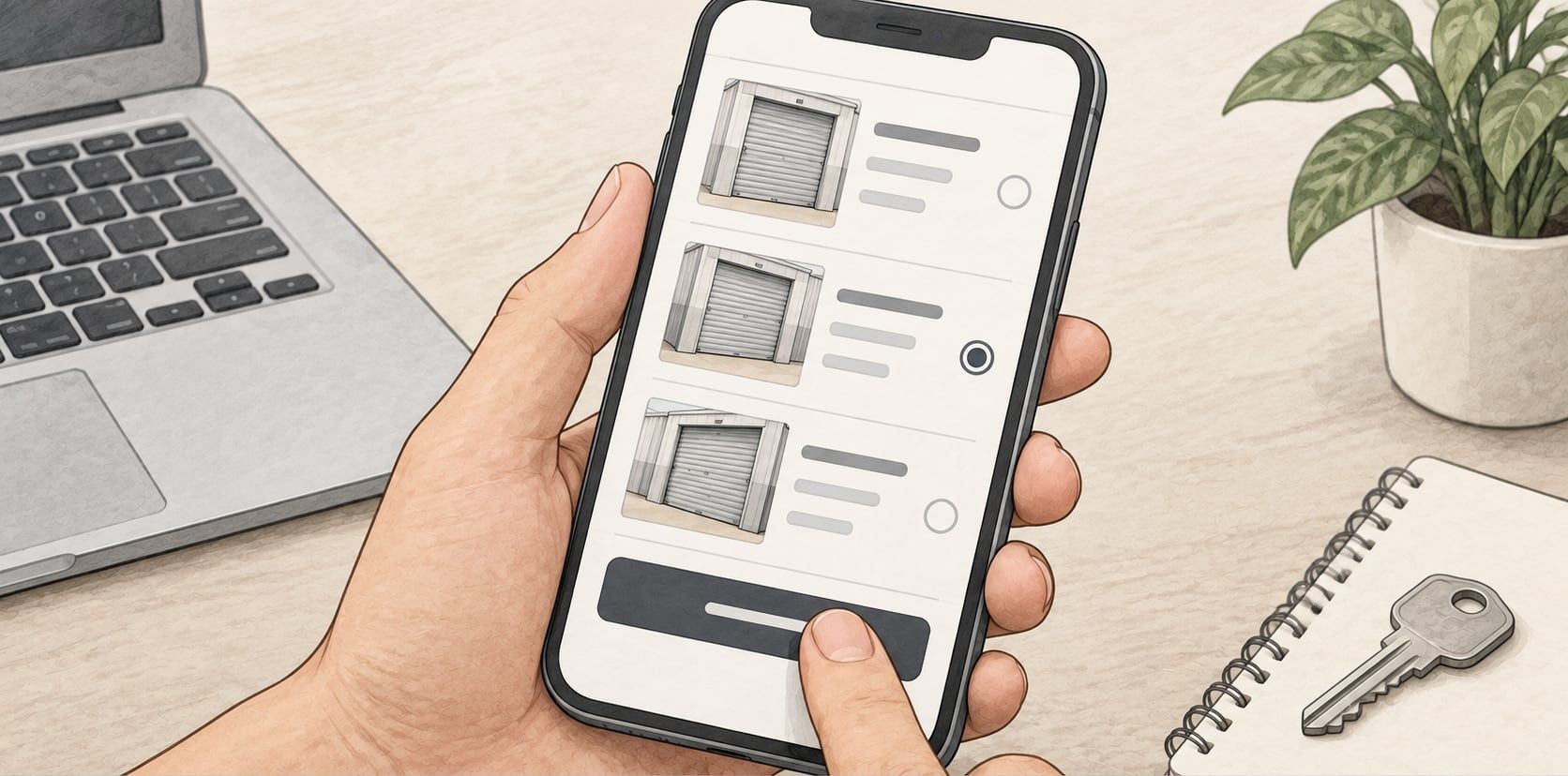
It's late, the house is quiet, and the move is three weeks off, so you sit down with your phone to sort out storage before another day goes by. How to rent a storage unit online comes down to a few steps in order: work out what you're storing, choose a size and a kind of unit, read the rate, go through the checkout, sign the lease on your phone, and bring your own lock on moving day.
We're a family-owned business renting storage units in Rockport, Texas, and we'd like you to go to bed that night with nothing left to wonder about.
Work out what you're storing
Before you look at sizes, make a list. Walk through each room and write down the big pieces, then count the boxes you expect to fill. The list is what you'll size the unit from, and it's much easier to rent the right unit once than to move into a second one later.
Measure the big pieces at their longest, deepest and tallest points, the arms of the sofa and the legs of the table included, and take a photo of each one while you're at it. A sofa 7 feet long and 3 feet deep covers 21 square feet of floor, and adding up a list that way tells you quickly how much floor you need.
If most of what you're storing is a household, our posts on what size storage unit you need for a two-bedroom apartment or house and a one-bedroom apartment start from a whole home's list, appliances included.
Choose a size
Choose a size by floor area. A 10x10 has 100 square feet of floor, a 10x15 has 150 and a 10x20 has 200, and the sizes either side of those are easiest to compare the same way. Our Size Guide sets the sizes side by side.
A sketch on graph paper is the surest check. Draw the floor of the size you're considering, one square for each foot, and cut out paper shapes for your big pieces at the same scale. If they fit with room for an aisle, the size will work. Our post on how big a 10x10 storage unit is walks through the sketch, and the 10x10 page covers that size in detail.
If you're between two sizes, choose by how you'll use the unit. The larger one leaves room for an aisle and for things added later, and the smaller one suits a load that goes in once and comes out once.
Check the longest piece too. Anything longer than 10 feet won't lie straight along the wall of a 10x10, though its floor measures a little over 14 feet corner to corner, so a long rug or a tall headboard laid down may go across on the diagonal.
Leave room for what's coming later. If more will go in after the first load, or you'll want to reach the back without unloading the front, a size with an aisle is worth more to you than one that fits on paper with no floor left over.
Choose drive-up or climate-controlled
At our property every unit is either drive-up or climate-controlled. A drive-up unit's door opens straight onto a concrete drive aisle, so you park at your unit door and unload a few steps.
Our climate-controlled units are interior units on an HVAC system, held within a steady temperature range. Each one is inside its building, and you reach it through the building entrance.
Which kind you want comes down to what you're storing and for how long. Wood furniture, pianos, photographs, papers and televisions are among the things that react to heat and cold, and our post on climate-controlled storage goes through why. Tools, garden gear, patio furniture and boxes of household goods suit a drive-up unit.
If your list has some of both, two units can make sense, one of each kind. If you're unsure about one particular piece, give us a call and describe it.
How much does a storage unit cost?
How much a storage unit costs depends on its size, the kind of unit and the place, so the answer comes from each company's own rates. The rate for every size we have open is on our price list, with a Rent Now button beside each one. Before you press it, it helps to know how storage rates are put together, here and anywhere else.
The price you see on a storage website is where to start, and three more things tell you what you'll pay: the standard rate written into the lease, any introductory discount and the date it ends, and the exact total for the day you move in.
With us, the standard rate is the monthly rent written in the lease from the first day. Compare it with the standard rate elsewhere, for the same size and the same kind of unit, and where a discount is shown, look for the standard rate beside it and the date it ends.
For the exact total on the day you plan to move in, call us during phone hours and we'll go through it with you. It's worth asking any company before you sign, so you know the first bill before it arrives.
Rent is due in full on the 1st. Write the standard rate, the due date and the notice period on your list for each place you're considering, so they're side by side when you choose.
Any later change comes with at least 30 days' written notice, because your signed lease requires it. Whichever company you rent from, ask to see the rate-change clause in its lease, in writing, before you sign, and read it the way you'd read any other contract.
Renting online, from the price list to the lease
You can rent a storage unit online with us from start to finish, from the price list to the signed lease, without a phone call, though you're welcome to call too. When you rent a storage unit online, the checkout opens once you press Rent Now on a size.
The checkout runs in three named steps:
- Select Storage Unit Size
- Enter Billing Info
- Confirm Information
Separately, you sign the lease on your phone. Read it through before you sign, the whole thing, including the paragraphs in bold.
If you'd rather talk it through before you rent, call us. We can go over which size suits your list, whether a drive-up or a climate-controlled unit fits what you're storing, and anything on the lease you'd like explained.
If you rent online, your gate code is emailed to you after you finish, and it works right away. Save the code somewhere on your phone besides the email, so it's handy at the gate.
Bring your own lock on moving day, since the lock on the door is yours. If it takes a key, keep the spare at home rather than on the same ring, and if it takes a combination, write the numbers down somewhere other than your wallet.
Those are the steps of renting online with us: the three checkout steps, the lease signed on your phone, and your own lock on moving day. How to get a storage unit anywhere else follows much the same path, with a lease to read and sign and a way in to learn.
Can I get a storage unit for just a month?
Whether you can rent a storage unit for a month, or use one as short-term storage, depends on the minimum term in the lease, so ask about it before you sign, wherever you rent. A storage lease can set a minimum term, and it's one of the first things to look for.
Our storage units are rented on a lease that continues month to month once its minimum term is met, and the rental carries on from one month to the next until it's ended in writing.
When you're ready to move out, give at least 10 days' written notice. Rent runs through the end of the month you move out in. If your move-out date falls in the last 10 days of a month, call us during phone hours and ask what you'll owe, so you know before you choose the day.
Say you're between leases, with a few weeks to fill before the new place is ready. Ask about the minimum term when you rent, and when the new keys are in your hand, give your notice and move the furniture across.
Month to month suits a short stay between homes, a few months while the house is worked on, or a season. It also helps when plans slip, as closing dates and repair schedules have a way of doing, because the rental carries on from month to month while you wait. Our post on long-term storage goes into longer stays, and the one on seasonal storage for Winter Texans and second homes covers the stays that come back every year.
Reading a storage unit rental agreement
A storage unit rental agreement, which you'll also see called a storage lease, is a contract, and it's worth an unhurried read before you sign it, the same as a lease on a house. Most of what you'll want to know sits in a handful of places, and it helps to look for them in order.
Find the rate and the due date first, then the paragraph on how the rate can change and how much notice comes with a change. Next, find the minimum term, how you end the rental and how much written notice it asks for, and what happens to rent in the month you leave.
Then find the paragraphs in bold or underlined print. In Texas, the paragraph on the storage company's lien on what's in your unit and the paragraph on whether notices can come to you by email are among them, because Texas law asks for both to stand out on the page.
Last, read what the lease says may not be stored, what needs permission first, and what it says about insurance. Check that your name, mailing address, email and phone number are right on the lease, since that's where any notice about your rental will go. If anything isn't clear, ask before you sign rather than after, and keep a copy of the signed lease where you can find it.
What should I know before renting a storage unit?
Before renting a storage unit, know what's in the lease you're signing, what Texas law says about unpaid rent, what your own insurance covers, what stays out of the unit, and when you can get in. Each one takes a few minutes, and it's a lot easier to learn before you sign than after. Our post on how to choose a storage unit turns them into a checklist.
The lease is the contract, so read it all. Texas law gives the storage company a lien on what's in your unit. Texas Property Code Section 59.021 says a lessor has a lien on all property in a self-service storage facility for the payment of charges that are due and unpaid by the tenant.
Section 59.041 lets a lessor enforce that lien by seizing and selling the property only under the terms of a contractual landlord's lien that's underlined or printed in conspicuous bold print in a written rental agreement, and only as the chapter allows. So when you read a storage lease, look for that bold or underlined paragraph and read it twice. Our post on how long before a storage unit is auctioned in Texas walks through the rest of the law.
Under Section 59.043, a notice about unpaid charges is delivered in person or sent to the email or postal address in your rental agreement, or to one you give the company in writing later. Keep yours current, and use an email address you actually check. The same section allows a notice by email only when the written rental agreement says so in underlined or bold print, so that's another paragraph worth finding.
If you serve in the military, our post on long-term storage covers military storage while you're deployed, with what Texas and federal law say about it.
Check your own insurance before your things go in. The Texas Department of Insurance says a home or renter's policy probably gives you some coverage for things stored away from home, usually limited to 10% to 20% of your personal property limit, and its advice is to check with your agent if you need more.
TDI also suggests telling your agent what you have and where you keep it, so they can make sure your coverage applies, and its reminder to renters is that some liability-only renters policies don't pay for your personal property at all. Our post on whether renters insurance covers storage units explains how to read yours.
Know what stays out. Food, gas cans and propane tanks are never stored with us, and anything with a fuel tank needs our written permission before it goes in. Our FAQ covers what goes in a unit, and our post on what a storage unit is for answers the common questions about it.
Know when you can get in. With us you'll have your own gate code, and you can get in from 5 AM until 10 every night, seven days a week. Our post on gated storage units explains how the gate, the codes and the hours work.
Timing a rental around the seasons on the coast
On this coast, a few dates are worth keeping in mind when you plan a rental. The National Weather Service gives the Atlantic hurricane season as running from June 1 to November 30 each year, and a summer move falls right inside it. Our post on hurricane storage on the Texas coast goes into what to move and when.
Summer is also the hot part of the year for carrying furniture, so book the truck for the early morning if you can, and give yourself the whole day.
Renting from out of town before you arrive
You can rent from anywhere, which helps if you're moving to Rockport from out of state or arriving for the winter. Choose the size, go through the checkout, sign the lease on your phone, and the gate code from an online rental is in your inbox before you've packed the truck. Our post on moving storage covers moving to Rockport with a unit in the middle, and the one on student storage covers renting from campus.
Plan to arrive while the gate is open. If the drive is a long one, an early start gets you to the gate with the whole day ahead for unloading, and the early hours are the cool ones for carrying.
Know your building letter and unit number before you set out. If you don't have them, call us during phone hours before you leave, so you're not looking for them at the gate with a loaded truck behind you.
Bring the lock with you, and a pen for marking the boxes you'll want first. Directions are on our Contact page.
A timeline for renting ahead of a move
Renting ahead of a move goes easiest with a few weeks in hand, and the jobs fall in a natural order.
Three or four weeks before, make the list and measure the big pieces. Sketch the floor of the size you think you need, and decide which things belong in a climate-controlled unit and which can go in a drive-up unit. Call your insurance agent and ask what your policy covers for things kept away from home.
Two weeks before, read the price list, choose the unit and press Rent Now. Go through the three checkout steps, read the lease on your phone and sign it, and keep the email with your gate code. Buy a lock that day so it isn't forgotten later.
The week before, pack the rooms you use least, label the boxes on the top and two sides, and number them on a list. Set aside the box of things you'll want on the first night in the new place.
On moving day, start early, load the truck with the back-wall things last so they come off first, and arrive while the gate is open. The next day, while it's fresh in your mind, check your list against the photo you took from the doorway and note anything that ended up somewhere unexpected.
Moving in
Every unit on the property is at ground level, and the buildings have ramps at their entrances, so a hand truck or a furniture dolly can do the heavy work. Load the back wall first with the things you'll want least, and keep the boxes you'll want often near the door.
The climate-controlled buildings have an after-hours alarm with live monitoring that alerts police, and it's set shortly after 10 PM, so plan to finish up inside the building before then.
Once the last box is in, put your lock on the door and take a photo of the unit from the doorway. It's the quickest way to remember where everything went when you come back for something.
Your gate code is yours alone, one code for each renter, so keep it private, and keep the email it came in.
Keep a few things together where you'll find them months from now: a copy of the signed lease, the email with your gate code, the key or combination to your lock, and your list of what's in each box. When you come back for something, everything you need to get in and find it is in one place.
What to bring on moving day
A little planning keeps moving day short. Bring these with you:
- your lock, and its key or combination
- your phone, with the email that has your gate code in it
- a hand truck or a furniture dolly for the heavy pieces
- furniture blankets for anything that will touch something else
- tape and a marker for the box that splits open
- a step stool, if you'll stack boxes above your shoulders
- water, plenty of it, on a hot day
The National Weather Service's heat advice is to do strenuous work at the coolest time of the day and to drink plenty of water even if you don't feel thirsty, which on a summer moving day on this coast means an early start.
Visiting the unit after you've moved in
Coming back for something is the easy part once the unit is set up well. You'll use the same gate code each time, any day of the week, between 5 AM and 10 at night.
Look at your list or the photo from the doorway before you go, so you know which stack to reach for. If you kept an aisle, walk straight to it; if you didn't, the boxes near the door will be the ones you packed to be reached.
On the way out, the gate opens without a code, and if your code ever gives you trouble, call us during phone hours.
How to cancel a storage unit and move out
To cancel a storage unit with us, give at least 10 days' written notice, then empty the unit on the day you planned. Moving out runs the same way as moving in, only in reverse, so line up the truck and the help for the day, and plan to finish while the gate is open.
Empty the unit completely, sweep it out, and take your lock off the door when you're done. Leave the unit the way you'd want to find it.
If you're clearing out a unit yourself rather than moving everything to a new home, sort as you go into what you keep, what you'll give away and what you'll recycle, and plan the donation drop-off and the recycling run for the day you empty the unit, so everything leaves it in one go.
On the day you move out, send us written notice that you've moved out, by email or on paper, so the move-out is on record the same day. Take a last photo of the empty, swept unit from the doorway before you go, and keep it with your copy of the lease.
If you'd rather stay longer than you planned, there's nothing extra to do. The rental carries on from one month to the next.
A short checklist before you press Rent Now
Before you rent, run down this list once:
- Your list of what's going in is written down, with the big pieces measured.
- You've chosen a size with room for an aisle if you'll want one.
- You've chosen drive-up or climate-controlled for what's going in.
- You've read the standard rate and the minimum term, and you know when the rent is due.
- You know how the rate can change and how much notice comes with it.
- You've checked what your own insurance covers away from home.
- You've bought a lock.
- You know when the gate is open and when you'll arrive.
If you're renting for a business, our Business Storage page covers how a unit can work for one.
Renting with us in Rockport
Rockport sits between Aransas Bay and Copano Bay, and 298 of our 558 units are climate-controlled. Our eleven single-level buildings went up between 2017 and 2025.
Siyata Storage is at 825 W Market Street. Some older listings show 835 — that is a separate private building next door, not us. Emilio answers the phone 8 AM–5 PM Monday–Saturday, and we respond to every message during those hours.
It's a relief to turn off the phone that night knowing the unit is rented, the lease is signed and the code is already in your email.
Tell us what you're storing and we'll help you pick a size. Call 361-200-1492, 8 AM to 5 PM Monday to Saturday. Hablamos español.