
Hurricane Storage on the Texas Coast: What to Move and When
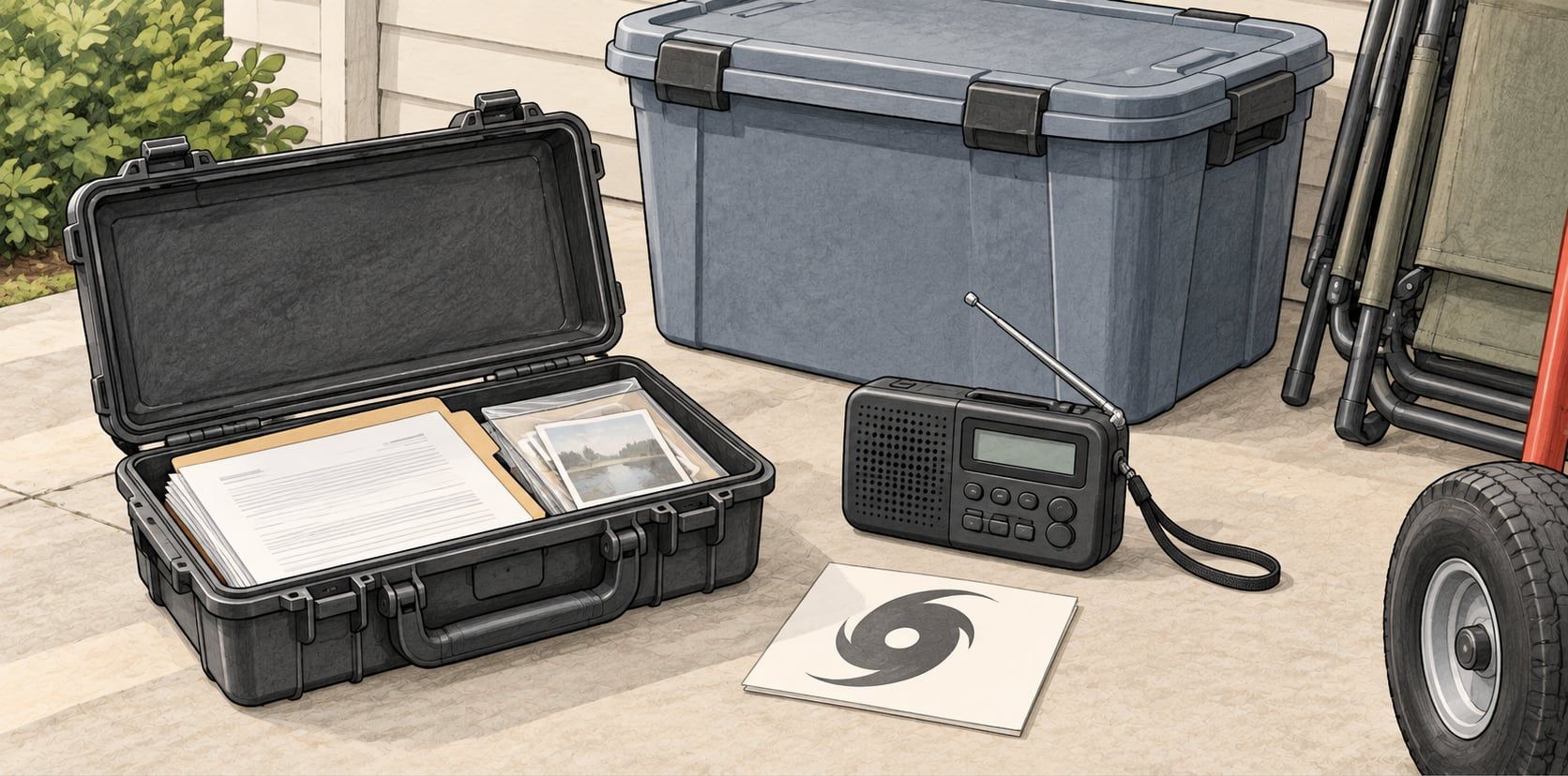
Hurricane storage is mostly about timing. Decide early in the season what you'd like out of the house and into a storage unit, move it before any storm is on the map, and keep the days before a storm for your family, your supplies and the instructions from local officials.
We're a family-owned business renting storage units in Rockport, Texas. There's a real calm in having the planning done early, so a forecast becomes a short list rather than a whole house.
When hurricane season runs
The National Weather Service gives the season as running from June 1 to November 30 each year, and Ready.gov's hurricane page gives the same dates for the Atlantic. That's six months, and hurricane season storage planned in spring covers all of it. The National Weather Service's planning page puts it plainly: the best time to prepare for a hurricane is before hurricane season begins on June 1.
Its checklist for that time includes writing or reviewing a family emergency plan, deciding how you'll reach each other, where you'll go and what you'll do, and reviewing your insurance policies for your home and personal property. Deciding what goes into storage fits naturally into the same afternoon.
The City of Rockport's hurricane preparations page asks residents to listen frequently to radio, TV and NOAA weather radio for bulletins and forecasts during the season. It's the same habit that tells you when to start a plan and when to finish one.
Should I move my things to storage before a hurricane?
If there are things you'd like out of the house during the season, move them early, well before any storm is forecast. A storage unit for hurricane season works best as part of a plan made in spring, with the moving finished long before any evacuation.
When a storm does form, the City's guidance is to follow the instructions issued by the Aransas County Emergency Operations Center, and to evacuate immediately if ordered to do so. Those hours belong to your family and your route out of town.
Ready.gov says the same thing in its own words: if local officials tell you to evacuate, do so immediately. Whatever you store, the part in your hands is the choosing, the packing, and a list and photos for your insurer. Planning the storage part of your season early means there's nothing standing between you and that instruction.
Watches, warnings and your timing
The National Weather Service's page on watches and warnings explains the two alerts that set the pace once a storm forms. The National Hurricane Center issues a hurricane watch 48 hours before it anticipates tropical storm-force winds, and a hurricane warning 36 hours before them.
At the warning, the Weather Service's advice is that all preparations should be complete, and to evacuate immediately if so ordered. That's the plainest reason to have the storage part of your plan done in June: by the time a watch is posted, the hours left are for supplies, the house and the road.
If you're new to the coast
Sign up for local alerts first. The City's preparations page asks residents to sign up for the Reverse Alert Information notification system, a reverse 9-1-1 program, and says you can choose to be notified by telephone, mobile phone, text message, email, or any combination.
Ready.gov's advice is to learn your evacuation routes, practice with your household and pets, and identify where you'll stay. It also suggests keeping your phone charged when a hurricane is in the forecast and having backup chargers, which matters when your list and photos live on that phone.
Ready.gov asks too that you check with neighbors, older adults and anyone who may need extra help with their hurricane plans.
Rockport's evacuation phases
The City of Rockport's phased evacuation page sets out six phases, counted back from the onset of 35-mile-an-hour winds. The City notes that the times are adjusted for the storm's speed and intensity, so the gaps between phases can be shorter or longer.
- Phase 1, about 40 hours before: voluntary evacuation of special-needs residents, nursing homes, home health care patients, tourists and vacationers in Aransas County.
- Phase 2, about 32 hours before: mandatory evacuation of those same groups, and of residents in mobile homes, along the waterfront and canals, or in low-lying areas that normally flood with heavy rains or high tides.
- Phase 3, about a day before: mandatory evacuation of all residents, apart from employees deemed essential by businesses such as banks, food service, pharmacies, fuel supply, grocery and emergency supply stores, and the oil, gas and chemical industry.
- Phase 4, about 16 hours before: mandatory evacuation of all remaining residents, as those essential businesses begin to reduce staff.
- Phase 5, about 8 hours before: mandatory evacuation of all residents, employees and volunteers left in Aransas County who have planned to leave, essential or not.
- Phase 6, about 4 hours before: mandatory evacuation of everyone still left in Aransas County.
The City's evacuation information page adds what to do when an order comes. If a mandatory evacuation is ordered, leave immediately, close up your home and take your pet with you. Anyone elderly or disabled who needs evacuation assistance can call 211 as soon as the evacuation is ordered.
Before departing, the City asks you to make sure you understand the projected path of the hurricane, and it points to TxDOT's evacuation maps for the area. Once a voluntary evacuation order is issued, the City sets up its communications several hours from Rockport and posts updates on its website and social media. Its evacuation page has the current contact details, so keep that page bookmarked on your phone.
Plan your storage moves so they're finished well before Phase 1 could be called. Packing and loading a unit can take a day or more of work, and once a storm is forecast, that day is better spent on supplies, the car and the route.
What to move into storage
Start with the things the City and Ready.gov both name. The City's page says to store lawn furniture and other loose, light-weight objects, such as garbage cans and garden tools, and Ready.gov's list includes bringing in outside furniture.
Patio furniture, grills without their propane tanks, planters, garden tools and outdoor decor all fit that description. A few notes on each:
- Patio furniture: clean it, rinse off the salt, and let the cushions air out before they're stacked.
- Grills: the propane tank stays home; clean the grates and close the lid.
- Planters: empty them, rinse them and stack them.
- Garden tools and hoses: wipe the tools clean and coil the hoses.
- Outdoor decor, wind chimes and flags: take them down and box them, labeled.
- Bikes, coolers and pool floats: rinse the bikes, leave the cooler lids open, and let the floats down.
The extras a household collects fit the plan too: the seasonal decorations, the furniture from a spare room, the boxes of books and keepsakes you'd rather have packed and labeled than spread around the house.
If your storm panels or plywood spend the off-season in a unit, plan to bring them home at the start of hurricane season, so they're at the house before any storm is forecast.
If the summer is when you're away, as it is for Winter Texans, the whole season's plan happens before you leave in spring. Our post on seasonal storage for Winter Texans and second homes covers that calendar.
If you're renovating, downsizing or between homes during the season, the furniture you'd store anyway is worth moving in early. Our post on moving storage covers using a unit around a move.
Food, gas cans and propane tanks are never stored with us, and anything with a fuel tank needs our written permission before it goes in, a lawn mower included. Batteries are never stored with us either.
Sizing a storm-season load
An outdoor load is mostly stacks and odd shapes, so it needs less floor than it looks. Here's one coastal backyard, worked out by floor:
| Item | How it's stored | Square feet |
|---|---|---|
| Patio table | Legs off, top on edge | 3 |
| Four patio chairs | Two stacks of two | 8 |
| Grill, 4 feet by 1 1/2, tank removed | Lid closed | 6 |
| Two bikes | Standing along a wall | 12 |
| Planters | Emptied and stacked | 3 |
| 10 lidded totes | Three high, four stacks | 15.5 |
That comes to about 48 square feet, inside a 5x10's 50, and our post on 5x5 and 5x10 storage units covers the small sizes. The totes are Sterilite's 27-gallon Industrial Tote, which measures 28 1/2 inches long and 19 5/8 inches wide on the outside, just under 4 square feet a stack. Add a spare room's furniture and the list moves up a size or two; our Size Guide covers all 13 sizes we rent.
What to keep with you through the season
Start with your papers. The City's page says to make sure your insurance information is up to date and in a single location so you can grab it in case of an evacuation, and that you can email it to yourself or keep it on a thumb drive or in the cloud.
Ready.gov adds that your insurance policies and personal documents, such as ID, should be up to date, with copies kept online behind a password. Keep originals of the documents you'd need on the road with you, and the copies in your email.
Your emergency supplies stay with you too. The City lists non-perishable food, water, batteries, cash and credit cards, and copies of medical prescriptions and insurance information, and Ready.gov suggests including medication and pet supplies in your go bag or car trunk.
The National Weather Service's planning checklist adds checking emergency equipment such as flashlights. Keep that kit in the house or the car, where you can reach it.
Keep the irreplaceable things close as well: the family photographs you couldn't replace, the papers you'd need on the road, the jewelry and the medicine.
A season's timeline
- Before June 1: decide what goes to the unit, rent it, and make your list and photos.
- Early June: move the patio furniture, the outdoor items and the extras into the unit.
- Through the summer: keep the list current, and check the unit when you're passing.
- When a storm is in the forecast: listen to radio, TV and NOAA weather radio, check your supplies, and get the car serviced and fueled, as the City advises.
- When officials give instructions: follow them, and evacuate immediately if ordered to.
- After the storm: wait for local officials' word before you travel, then check the house and the unit.
- After November 30: bring the outdoor things home, or leave them in for the winter.
Packing for storm season
Pack as if the boxes will stay put for months, because they may. Clean everything, let it air out completely, and pack fabrics and papers in lidded plastic bins rather than cardboard.
Set the bins and boxes on pallets or boards rather than straight on the floor, leave a little space between the stacks and the walls, and keep a path down one side. Label every box on two sides and keep a numbered list. Put the boxes you'd want first after a storm, such as spare bedding, towels and work gloves, nearest the door.
Clean the patio cushions, rinse the outdoor furniture of salt, and let everything air out before it's stacked. If a spare refrigerator is going in, GE Appliances' storage advice for one going out of use for more than a month is to remove all the food, unplug it, clean the inside, wipe it out and leave the doors open. Brown Jordan's care guide for its furniture says to clean all furniture before storing to prevent stain set and material breakdown.
Our post on how to prevent mold in a storage unit goes through packing for the coast in detail, and the one on how to pack for storage goes box by box.
Checking the unit during the season
When you're passing in the summer, stop at the unit for a few minutes. Check the list against what's there, make sure the bottom boxes are sitting on their boards, and add anything new to the list and the photos.
After a stretch of heavy rain, a visit is worth it too. Our post on mold covers what to look for, and the Canadian Conservation Institute's notes on storage areas suggest briefly inspecting stored things to make sure they're adequately covered, well supported and in their proper places.
Your inventory and your insurance
Make the list before the season, not during a storm. The Texas Department of Insurance's home insurance guide says a complete list of your property will help you decide how much coverage you need and will make filing claims easier, and it suggests photographing each room and opening drawers to photograph what's inside.
Do the same for the unit: a photo of each box open and closed, and one of the loaded unit from the door. Email the list and the photos to yourself, so they travel with you whatever happens to the paper copy. TDI's guide also says to update your list regularly, so add to it whenever something goes in or comes out.
Then check the coverage. The Texas Department of Insurance's page on storage units says a home or renter's policy probably gives you some coverage for things stored away from home, usually limited to 10% to 20% of your personal property limit, and that you'll need a separate policy for flood damage.
TDI's home guide adds that if you live on the Texas coast, your home policy might not cover wind and hail damage, and that most flood policies have a 30-day waiting period before they start. The weeks before June are the time to ask your agent. Our post on renters insurance and storage units goes through the questions.
Getting to the unit during the season
Rent before the season starts if you can. If you rent online, your gate code is emailed to you after you finish, and it works right away, and you read and sign the lease on your phone.
You can get in from 5 AM until 10 every night, seven days a week. Bring your own lock, and keep the gate code both in your phone and on paper.
Summer moves are hot work. NOAA's climate normals for the Corpus Christi airport, southwest of Aransas County, give a normal daily high of 91.6 degrees in June, and the National Weather Service's heat advice is to reduce, eliminate or reschedule strenuous activities until the coolest time of the day, and to drink plenty of water even if you don't feel thirsty. An early start at the 5 AM gate keeps the carrying in the coolest hours.
Ask about the minimum term when you rent. Our storage units are rented on a lease that continues month to month once its minimum term is met, and the rental carries on from one month to the next until it's ended in writing, which suits a season that runs six months.
After the storm
Ready.gov's advice after a hurricane is to pay attention to local officials for information and special instructions, and the City of Rockport keeps a page for after the hurricane hits.
The City's advice is to watch the news media and the City's website for the best time to return, and not to return until the evacuation order is lifted. It also suggests calling your insurer to start the claim process even if you don't yet know the extent of the damage, and bringing back a supply of water. Look after the house and the people first.
When you get to the unit, open the door and let it air out, check the bottom boxes and anything near the door, and compare what you see with your list and photos. Ready.gov's advice is to document any property damage with photographs and contact your insurance company for assistance.
If your home needs repairs after a storm, the furniture can wait in a unit while the work is done and come home when the rooms are ready. Our post on long-term storage covers stays of many months.
If you run a business, Ready.gov's list includes making sure the business has a continuity plan to keep operating when disaster strikes. Stock, spare equipment and boxed records that you'd keep anyway can go into a unit in June along with everything else, listed and photographed the same way.
A storm-season checklist
- Before June 1, make or review your family plan and check your insurance.
- Decide what goes into storage, and rent the unit.
- Clean, air out and pack the outdoor things and the extras, and label every box.
- Make a list and photos of the house and the unit, and email them to yourself.
- Keep your documents, medication and emergency supplies with you.
- Sign up for local alerts and know your evacuation route.
- When a watch is posted, turn to supplies, the house and the road.
- After a storm, return when officials say so, then check the house and the unit.
Hurricane storage with us in Rockport
Rockport sits between Aransas Bay and Copano Bay, and 298 of our 558 units are climate-controlled. Our climate-controlled units are interior units on an HVAC system, held within a steady temperature range. Our drive-up units open onto the drive aisles, where you park at your unit door and unload a few steps.
Our eleven single-level buildings went up between 2017 and 2025, every unit is at ground level, and every unit has a wind-rated door. Our About page has more about the property.
Siyata Storage is at 825 W Market Street. Some older listings show 835 — that is a separate private building next door, not us. Directions are on our Contact page.
The rate for every size we have open is on our price list. Emilio answers the phone 8 AM–5 PM Monday–Saturday, and we respond to every message during those hours.
Tell us what you're storing and we'll help you pick a size. Call 361-200-1492, 8 AM to 5 PM Monday to Saturday. Hablamos español.